Philadelphia Container Drayage Guide: Ports, Rail & Regional Delivery
A practical guide to container drayage across the greater Philadelphia and Delaware River port and intermodal market, covering Packer Avenue, Tioga, Penn Terminals, Wilmington, Gloucester, and CSX and Norfolk Southern rail, plus carrier access, reefer and genset planning, free time, and regional delivery.
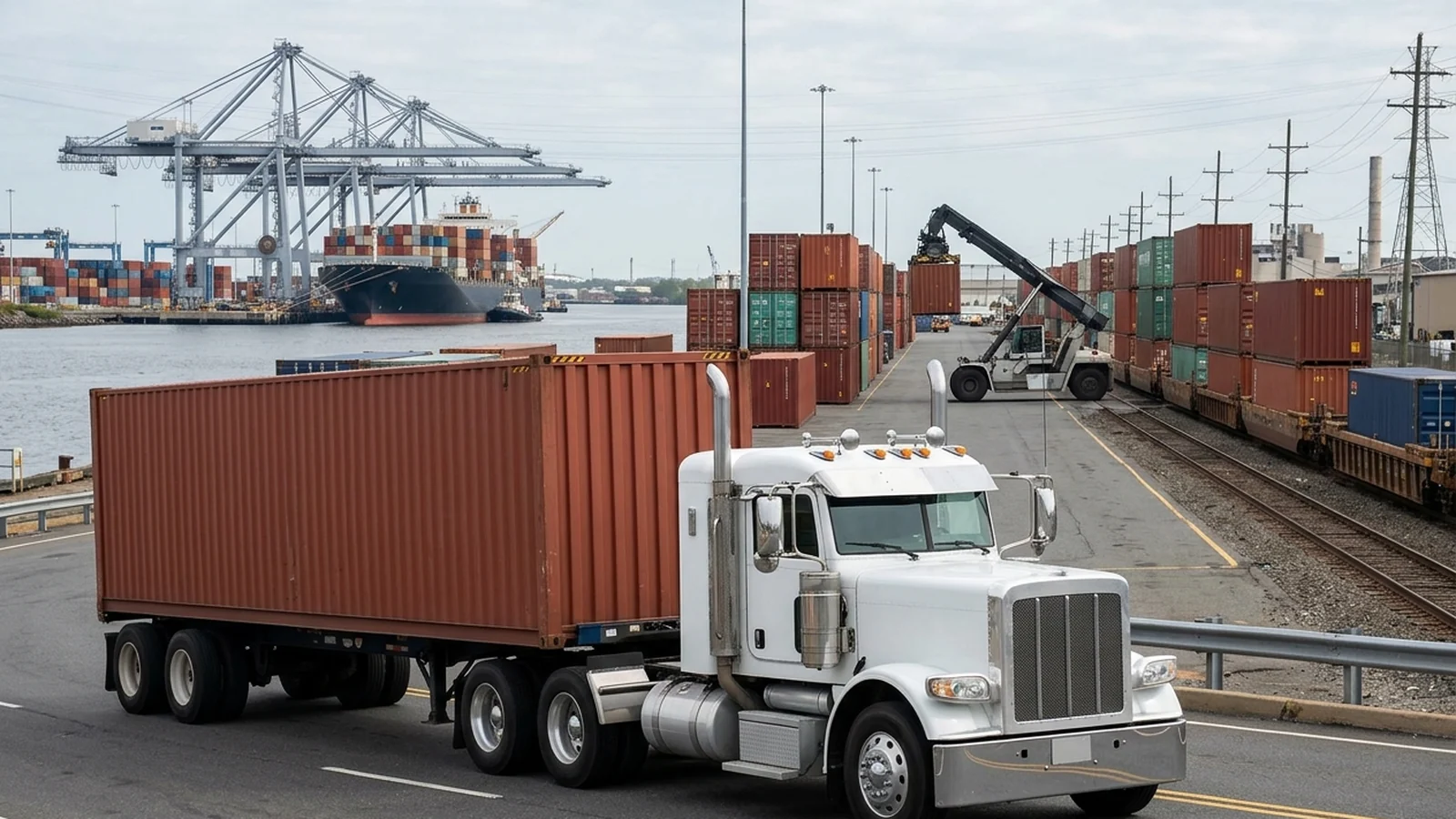
Philadelphia container drayage is not one terminal and it is not one operation. The greater Philadelphia and Delaware River market is a cluster of marine terminals on both sides of the river, plus intermodal rail ramps served by two different railroads, spread across Pennsylvania, New Jersey, and Delaware. A container moving through this market can start at a South Philadelphia marine terminal, a terminal in North Philadelphia, a terminal in Eddystone, a fruit terminal in Wilmington, a terminal on the New Jersey side at Gloucester, or a rail ramp that has nothing to do with the water at all.
For importers, exporters, produce companies, food distributors, freight forwarders, NVOCCs, brokers, manufacturers, retailers, and logistics teams, that variety is exactly why planning matters. The words "Philadelphia port" or "Philadelphia rail" do not tell a drayage provider enough to plan, price, or dispatch a move. This guide explains how the region actually works, why the exact terminal or rail ramp changes the plan, why a carrier's access and agreements matter as much as its trucks, and what information keeps a container moving cleanly.
If you want the underlying drayage mechanics that apply at any U.S. port, including chassis, free time, appointments, and empty returns, start with Container Drayage Explained.
None of what follows is terminal policy or legal advice. Terminal, railroad, carrier, and equipment requirements change and vary by shipment. Always confirm current requirements with the specific facility, ocean carrier, railroad, and equipment provider involved in your move.
Understanding the Greater Philadelphia / Delaware River Container Market
It helps to think in terms of a regional market rather than a single port. The main pieces include:
- Philadelphia, South Philadelphia waterfront. Home to Packer Avenue Marine Terminal and to intermodal rail on the Christopher Columbus Boulevard corridor.
- Philadelphia, North Delaware Avenue / Port Richmond. Home to Tioga Marine Terminal, a separate multipurpose terminal several miles from Packer Avenue.
- Chester and Eddystone, Pennsylvania. Just south of the city, where Penn Terminals operates.
- Wilmington, Delaware. Farther south on the Delaware River, a major refrigerated and fresh-fruit gateway.
- Gloucester City, New Jersey. On the New Jersey side of the river, a significant perishable and refrigerated terminal.
- Regional intermodal rail. CSX and Norfolk Southern each operate intermodal facilities that serve the Philadelphia market from different locations.
For clarity, the greater Philadelphia and Delaware River gateway is best understood as a network of facilities:
- Marine terminals: Packer Avenue Marine Terminal, Tioga Marine Terminal, Penn Terminals, Port of Wilmington, and the Gloucester Marine Terminal.
- Intermodal rail: CSX and Norfolk Southern.
These facilities are not interchangeable. They can serve different ocean services, handle different commodities and equipment, and carry different access, release, and reefer requirements. A container discharged at Wilmington is a different move than a container grounded at a rail ramp in Bucks County, and a container at Tioga in North Philadelphia is a different move than one at Packer Avenue in South Philadelphia, even if all of them deliver to the same warehouse. Because of that, "Philadelphia port" or "Philadelphia rail" is a starting point, not a dispatchable instruction. The exact terminal, or the exact railroad and ramp, has to be identified before anything can be planned.
Packer Avenue Marine Terminal
Packer Avenue Marine Terminal is the primary container terminal on the South Philadelphia waterfront, operated by Greenwich Terminals LLC under PhilaPort. It handles import and export container traffic across a range of ocean services and is a major refrigerated gateway, with extensive reefer plug capacity and on-terminal refrigerated warehousing that supports the region's perishable business.
For drayage planning, Packer Avenue is often the terminal people mean when they say "Philadelphia port," but that assumption is exactly what causes errors. Import moves here depend on the usual gates, vessel discharge, availability, customs and carrier release, any holds, and appointment or access requirements, and reefer cargo adds power and monitoring requirements on top. The practical point is to confirm that the container is actually at Packer Avenue, and not at one of the other Delaware River terminals, before building the move.
Tioga Marine Terminal
Tioga Marine Terminal is a separate PhilaPort facility on the North Delaware Avenue waterfront in the Port Richmond area of Philadelphia, several miles from Packer Avenue in South Philadelphia. It is owned by PhilaPort and operated by Delaware River Stevedores, Inc. (DRS).
Its operating profile is different from Packer Avenue. Tioga is a multipurpose terminal that handles a broad mix of cargo, including containers, breakbulk, steel, forest products, roll-on/roll-off, project cargo, and over-dimensional freight, supported by mobile harbor cranes, container top-lifts, and on-site warehousing that includes temperature-controlled space. Where Packer Avenue is primarily a container terminal, Tioga's mix means a move there can involve container drayage, specialized or heavy handling, or project and breakbulk considerations, depending on the cargo.
For a drayage customer, the practical point is identification. "Philadelphia port" does not distinguish Tioga from Packer Avenue, and the two are in different parts of the city with different operating profiles, cargo handling, and access details. Saying "Tioga" specifically tells the provider which waterfront, which operator, and what kind of handling may be involved.
As with every terminal in the market, drayage planning at Tioga depends on the specific terminal, the equipment, the ocean carrier, and the cargo involved. Container size and type, any specialized or over-dimensional handling, reefer requirements where applicable, release status, and equipment needs should all be confirmed for the specific move rather than assumed from the general "Philadelphia" label.
Penn Terminals
Penn Terminals, operated as PSA Penn Terminals, is located in Eddystone, Pennsylvania, south of Philadelphia. It is a multipurpose terminal that handles containerized and perishable cargo and is a significant node in the Delaware River cold chain, with substantial on-dock refrigerated warehouse space and ship-to-shore cranes.
Operationally, Penn Terminals is not Packer Avenue. It is a different location with its own ocean services, access procedures, and handling profile, and the drive time and routing to a given warehouse can differ meaningfully. A container at Penn Terminals in Eddystone should never be planned as if it were at Packer Avenue in South Philadelphia. The exact terminal drives the routing, the chassis plan, the release steps, and the delivery timing.
Port of Wilmington
The Port of Wilmington, in Wilmington, Delaware, operated by Enstructure, is one of the most important refrigerated and fresh-fruit gateways in North America. It is widely recognized as a leading banana port and a primary entry point for Chilean winter fruit, supported by extensive dock-side cold storage across multiple refrigerated warehouses, with a pronounced seasonal peak in the winter and spring produce months.
For a logistics team, Wilmington matters for two reasons. First, if the freight is perishable, there is a real chance it moves through Wilmington rather than a Philadelphia terminal, and the reefer and appointment planning has to reflect that. Second, Wilmington is farther south, so a delivery to a Philadelphia-area or Pennsylvania warehouse from Wilmington is a longer regional drayage move than a pull from Packer Avenue, with different mileage and scheduling. Exact terminal and ocean-carrier requirements still apply, and they are confirmed per shipment.
Gloucester Marine Terminals
On the New Jersey side of the Delaware River, the Gloucester Marine Terminal, operated by Gloucester Terminals LLC in Gloucester City, New Jersey, is another major refrigerated and perishable gateway, with large refrigerated storage capacity and reefer plug infrastructure supporting fruit and vegetable imports.
A Gloucester move differs from Packer Avenue, Tioga, Penn Terminals, and Wilmington in a basic way: it is across the river in New Jersey. That affects routing to a given receiver, and it can change the practical planning even when the delivery address is identical to what a Philadelphia pull would serve. As with the other terminals, the operating requirements are terminal-specific and confirmed for the move, and perishable freight carries its own reefer and appointment considerations.
Philadelphia Intermodal Rail: CSX and Norfolk Southern
Not every container in this market comes off a ship. A large share of intermodal freight reaches the Philadelphia area by rail, and rail drayage is a different operation than marine-terminal drayage.
Two railroads serve the market from different facilities:
- CSX operates an intermodal terminal on the South Philadelphia waterfront, commonly referred to as the Greenwich terminal, on Christopher Columbus Boulevard.
- Norfolk Southern serves the immediate Philadelphia area primarily through its Morrisville intermodal facility in Bucks County, Pennsylvania, northeast of the city, with double-stack service to Midwest destinations.
These are different railroads at different locations, which is why "Philadelphia rail" is not a dispatchable instruction any more than "Philadelphia port" is. The exact railroad and the exact ramp have to be identified.
Rail drayage differs from marine drayage in several practical ways:
- Container availability and grounding. A rail container has to be grounded and shown as available at the ramp, which is a different status than a vessel discharge at a marine terminal.
- Railroad release and pickup information. Rail moves typically depend on the railroad's release and on correct pickup or reservation information, and the correct container or trailer number is essential.
- Access and interchange. Ramp access and equipment interchange at a railroad are governed by the railroad's own requirements, which are not the same as a marine terminal's.
- Chassis and equipment. Chassis sourcing and equipment arrangements at a rail ramp can differ from a marine pull.
- Storage and free time. Rail ramps have their own storage and free-time rules, distinct from terminal demurrage.
- Appointments and access procedures. Where they apply, they are set by the ramp and railroad.
- Regional delivery and equipment disposition. After delivery, the empty equipment has to be returned or dispositioned according to the railroad and equipment provider, and that leg is part of the move.
Spartanus Cargo Systems services qualifying container moves from both CSX and Norfolk Southern intermodal facilities serving the Philadelphia market, subject to shipment requirements, equipment availability, and operating conditions. As with marine terminals, the exact railroad and ramp still have to be identified before a rail move can be planned or priced.
Why Carrier Access Matters
This is one of the most important and least understood parts of Philadelphia drayage. Moving a marine or rail container takes more than a tractor, a driver, and a TWIC card.
Access to a terminal or rail facility does not necessarily mean a motor carrier can move every container or piece of equipment from that location. Depending on the steamship line, railroad, terminal, chassis provider, and equipment involved, the carrier may also need the appropriate insurance, interchange agreements, equipment relationships, and operating requirements in place before the move can be accepted.
In practice, a carrier's ability to accept a specific move can depend on:
- Terminal access credentials.
- Railroad access and ramp eligibility.
- Insurance coverage that meets the relevant requirements.
- Equipment interchange agreements.
- Steamship-line requirements.
- Railroad requirements.
- Equipment-provider relationships.
- Chassis arrangements.
- Specialized equipment.
- Reefer genset capability where required.
Spartanus maintains the operating relationships, equipment access, and qualifying interchange arrangements needed to support container movements across the marine terminals and rail facilities it serves, subject to shipment requirements, equipment availability, and operating conditions.
The takeaway for importers is practical, not promotional: before awarding a container load, confirm that the carrier can actually accept and move the specific container and equipment from the specific terminal or rail ramp involved. Access to one facility, or the ability to handle one steamship line, does not automatically extend to every terminal, railroad, or equipment type in the market.
Moving containers through the Philadelphia port or rail market?
Send the terminal or rail ramp, delivery location, container details, equipment requirements, and timing to Spartanus Cargo Systems so our team can review the complete move and available capacity.
Request a QuoteWhat Happens Before an Import Container Can Be Picked Up
At a marine terminal, several conditions generally have to line up before a container is deliverable:
- Vessel discharge. The container is off the ship and grounded.
- Availability. The terminal shows the unit as available, not just discharged.
- Customs release. The shipment is released by U.S. Customs and Border Protection and is not under a hold or exam.
- Freight release. The ocean carrier has released the freight, which often depends on documentation and payment.
- Holds. Any terminal or other holds are cleared.
- Terminal availability and appointment. Where an appointment or access window applies, it is secured.
- Chassis and equipment. The correct chassis or equipment is arranged.
Rail pickup follows a related but distinct path. Instead of a vessel discharge, the container has to be grounded and available at the ramp, the railroad has to release it, and the correct pickup or reservation information and container or trailer number have to be in hand. A container can be "on the ground" and still not be pullable if the release or paperwork is incomplete. In both cases, status should be tracked actively rather than assumed.
Chassis and Equipment Planning
An ocean container rides on a chassis, and the equipment is not a detail. Planning generally has to account for:
- Standard chassis for typical dry container moves.
- Specialized chassis for specific container sizes or configurations.
- Overweight equipment where the cargo weight requires it.
- Reefer equipment, including genset capability where the move needs portable power.
- Chassis-provider considerations, since chassis can be supplied through ocean-carrier arrangements or through pools and providers, and availability can shift.
- Compatibility and interchange, since not every piece of equipment is freely interchangeable across providers or facilities.
Because chassis and equipment arrangements can differ by terminal, by railroad, and by ocean carrier, they should be confirmed while planning the move rather than discovered at the gate or the ramp.
Refrigerated Containers and Perishable Freight
The Delaware River market is one of the most important refrigerated and perishable gateways in the country. Wilmington is a leading fresh-fruit and banana port, Gloucester and Penn Terminals carry significant refrigerated and perishable volume, and Packer Avenue has extensive reefer capacity. If you move produce, food, or other temperature-sensitive freight, reefer planning is central, not optional.
Reefer drayage typically involves:
- A confirmed set temperature.
- Reefer power, including a genset where the container needs portable power in transit.
- Monitoring expectations during the move.
- Receiving appointments at cold-storage and perishable warehouses, which are often tighter and more time-sensitive.
- Equipment checks before dispatch.
For refrigerated container work, Spartanus has dedicated underslung genset chassis available for qualifying moves. An underslung genset is a diesel generator mounted underneath the chassis that powers the refrigerated container while it is being trucked, rather than relying on a separate clip-on genset that has to be located and mounted for the move. This can reduce dependence on locating and mounting a separate portable genset when the container, lane, and operating requirements are compatible. Equipment availability, container compatibility, and shipment requirements still have to be confirmed for each move, and not every reefer movement will use this equipment.
Because the region's perishable freight is time-sensitive, reefer requirements should be communicated at the start of the quote or capacity conversation, not after a truck is assigned. Coordination between the terminal or ramp, the transportation provider, the receiver, and the equipment provider is what protects the cold chain through the drayage leg.
When the Container Is Available Before the Warehouse Is Ready
One of the most common problems in this market has nothing to do with the port itself. It is timing between the container's availability and the receiver's appointment.
A container can become available at a terminal or a rail ramp before the receiver has an open appointment to take it. When that happens, the loaded container may need to wait, which can push it toward the last free day and can involve additional equipment time. In other cases the receiver has an appointment before the container is released, and the move cannot start yet.
For customers that need additional flexibility between the terminal or rail ramp, warehouse, or staging location, Spartanus can provide a dedicated yard-move fleet where operationally appropriate and subject to capacity. This can help separate the initial container pull from the final delivery when receiving schedules, free-time pressure, staging requirements, or warehouse timing make a direct move impractical. This applies to both marine terminals and rail ramps, and it can help when multiple containers need to be staged or repositioned rather than delivered straight through.
Free Time, Demurrage, Detention, Rail Storage and Empty Returns
These terms describe different exposures, and mixing them up leads to surprises.
- Terminal free time is the period a container can sit at a marine terminal before charges may begin.
- Demurrage is generally associated with a loaded container remaining at the terminal beyond its allowed free time.
- Detention is commonly associated with carrier or ocean-carrier equipment being held outside the terminal longer than allowed.
- Rail storage is the rail ramp's own version of free-time and storage charges, and it operates on the railroad's rules, not a marine terminal's.
- Equipment free time can apply to chassis and other equipment.
- Empty return and equipment disposition close the cycle, and the correct return location or disposition can differ by carrier, provider, and facility, and can change after delivery.
The exact rules, amounts, and definitions vary by terminal, railroad, ocean carrier, equipment provider, and contract, and this is not legal advice or a single universal rule. The operational takeaway is to know the last free day and any storage status early, and to plan the full cycle, including the empty or equipment disposition, rather than treating it as an afterthought.
Overweight and Specialized Containers
Heavy and specialized containers require planning before dispatch, not correction after it. Depending on the move, that can involve:
- The correct chassis or equipment configuration.
- Axle-weight planning so the load is legal on the road.
- Routing that accounts for weight and any restrictions.
- Permits where applicable.
- An operational review before the equipment is assigned.
Legal weight limits and permit requirements are jurisdiction-specific and change, so they are confirmed for the specific move rather than assumed. The core rule is to identify weight and any special handling early, so cargo weight and commodity details belong in the initial shipment information.
Local Drayage vs Regional Container Transportation
Not every move from this market is a short local delivery. Containers routinely move from the Philadelphia and Delaware River terminals and rail ramps into Pennsylvania, New Jersey, Delaware, Maryland, New York, Connecticut, and other commercially appropriate regional markets.
The planning principles are the same regardless of distance, but longer moves leave less room to recover from a missed step, so the container, equipment, appointment, receiver, time limits, and empty return all have to be coordinated up front. Whether a move is best handled as a spot container or as dedicated or recurring capacity often depends on volume and lane consistency.
For import containers moving through the New York and New Jersey gateway, see our Port Newark & Port Elizabeth drayage guide.
Information to Give Your Drayage Provider
The more complete the initial information, the more accurately a move can be planned and priced, and the fewer problems appear at the gate or the ramp. A useful Philadelphia-market drayage request generally includes:
- Marine terminal or rail ramp
- Railroad, if applicable
- Steamship line, if applicable
- Container number
- Trailer number, if applicable
- Container size and type
- Release status
- Customs status
- Rail release or pickup information, if applicable
- Last free day or storage status
- Delivery address
- Receiver appointment or receiving hours
- Cargo weight
- Commodity
- Hazmat status, if applicable
- Reefer set point, if applicable
- Genset requirement, if applicable
- Chassis requirement
- Special equipment, if any
- Empty return or equipment disposition instructions, if known
Not every field is known at the same moment, but sharing what is available early, and updating the rest as it firms up, is what lets a provider plan the move instead of reacting to it.
Common Philadelphia Drayage Planning Mistakes
Most problems in this market repeat. The most common include:
- Assuming "Philadelphia port" identifies the terminal, when the move may involve Packer Avenue, Tioga, Penn Terminals, Wilmington, Gloucester, or another facility in the regional port network.
- Assuming "Philadelphia rail" identifies the railroad or ramp, when CSX and Norfolk Southern operate different facilities in different places.
- Choosing a carrier before confirming that it can accept and move the container from the specific terminal or rail ramp, with the required access, insurance, interchange, and equipment.
- Waiting until the last free day to begin serious planning.
- Ignoring warehouse appointment timing.
- Failing to plan genset or chassis needs on reefer moves.
- Treating the empty return or rail equipment disposition as an afterthought.
- Not identifying overweight or specialized freight early.
- Providing incomplete release or pickup information.
Each of these is avoidable with information and lead time, which is what the checklist above is for.
Philadelphia Is Where Spartanus Started
Philadelphia is more than another service market for Spartanus Cargo Systems. It was the company's first port of operation and the market where its container drayage operation began.
That history matters because the Philadelphia market requires more than simply having trucks available. Different marine terminals, rail ramps, steamship lines, equipment providers, receiving schedules, and reefer requirements can change the operating plan from one container to the next. Operating in this market helped shape Spartanus Cargo Systems' focus on marine-terminal drayage, intermodal rail, refrigerated containers and perishable freight, dedicated yard-move capacity, underslung genset chassis, overweight and specialized container planning, regional container transportation, and the terminal-specific and equipment-specific requirements that determine whether a move can be accepted.
Today, Spartanus continues to support qualifying container movements across the greater Philadelphia and Delaware River market, including marine terminals, CSX and Norfolk Southern rail facilities, refrigerated and specialized container freight, dedicated yard-move operations, and regional delivery, subject to equipment availability, interchange requirements, and shipment and operating conditions.
Planning Philadelphia / Delaware River Container Drayage
Container drayage in the Philadelphia and Delaware River market rewards specificity. The terminal or ramp, the railroad, the steamship line, the release, the chassis and equipment, the reefer requirements, the appointment, the free-time and storage clocks, and the empty return all shape the move, and none of them are captured by "Philadelphia port" or "Philadelphia rail" alone. Whether the container is at Packer Avenue, Tioga, Penn Terminals, Wilmington, Gloucester, or a CSX or Norfolk Southern rail ramp, the teams that move freight cleanly here are the ones that identify the exact facility and confirm carrier eligibility before the container is even available.
Spartanus Cargo Systems provides container drayage and regional container transportation across the greater Philadelphia and Delaware River market, the company's first port operating market, including import and export containers, dry and refrigerated container drayage, hazmat where requirements are met, overweight containers where legally and operationally appropriate, marine-terminal and intermodal rail moves, a dedicated yard-move fleet, and dedicated underslung genset chassis, subject to equipment availability, interchange requirements, and shipment conditions.
If you are planning containers through the Philadelphia port or rail market, send the terminal or rail ramp, delivery location, container details, equipment requirements, and timing so the complete move can be reviewed before dispatch.
Related Insights
Container Drayage Explained: Import, Export, Chassis, Free Time & Empty Returns
A practical guide to container drayage for importers, exporters, brokers, and logistics teams, covering terminal pulls, chassis, appointments, free time, empty returns, and the details that keep containers moving.
Read More
Demurrage, Detention, Free Time & Storage Explained for Container Freight
A plain-language guide to free time, demurrage, detention, terminal storage, and chassis timing on container freight, including the last free day, empty returns, who typically controls each clock, and how drayage planning can reduce avoidable exposure.
Read More
Hazmat Container Drayage: What Shippers Need to Know
A practical guide to hazmat container drayage for shippers and logistics teams: what changes operationally, why classification and documentation belong upstream, how driver, equipment, terminal, routing, and empty-return requirements are confirmed, and what to disclose before quoting.
Read MoreStart the Capacity Discussion
Spartanus Cargo Systems provides container drayage, refrigerated container transportation, specialized container services, and regional freight solutions across key Mid-Atlantic and Gulf Coast markets.